A Non-Drug Product Passed Off as a Drug Was Legally Deemed a Counterfeit Drug
“BAO SHU TANG” Prevails in Compound Camphor Cream Rights-Enforcement Case
(I) Criminal Proceedings
October 17, 2022 — Market regulation authorities conducted an on-site seizure
April 4, 2023 — The public security authority issued a recommendation for prosecution
April 8, 2024 — The People’s Procuratorate filed a public prosecution
January 7, 2025 — First-instance criminal judgment, (2024) Lu 0614 Xing Chu No. 295 (Yantai Baofuling Biotechnology Co., Ltd., Gong Peizhou, and Gong Jucong were convicted of manufacturing and selling counterfeit drugs)
(II) Civil Proceedings
January 16, 2025 — Beijing Bao Shu Tang Scientific Pharmaceutical Co., Ltd. (“Bao Shu Tang”) filed a civil action
September 12, 2025 — The Yantai Intermediate People’s Court entered a first-instance judgment in (2025) Lu 06 Min Chu No. 5 in favor of Bao Shu Tang (Yantai Baofuling Biotechnology Co., Ltd., Gong Peizhou, Gong Jucong, and Sun Xin were jointly found liable for trademark infringement and unfair competition)
March 27, 2026 — The Shandong High People’s Court issued a final judgment affirming the first-instance judgment
Bao Shu Tang Compound Camphor Cream, a longstanding topical medicine widely trusted by consumers, was unlawfully imitated when offenders manufactured and sold a non-drug product as a drug and exported it to markets in Southeast Asia. Recently, the Shandong High People’s Court issued a final judgment in the dispute brought by Bao Shu Tang against Yantai Baofuling Biotechnology Co., Ltd. (“Yantai Baofuling”), Gong Peizhou, Gong Jucong, and Sun Xin for joint trademark infringement and unfair competition. The court dismissed the appeal and affirmed the first-instance judgment. The responsible parties had previously been held criminally liable for manufacturing and selling counterfeit drugs, resulting in a representative case of comprehensive intellectual-property protection combining criminal accountability with civil compensation. The case was also selected as one of the “2025 Annual Cases of Judicial Protection of Intellectual Property Rights by Yantai Courts.”
Another important aspect of the case is that the courts recognized that the packaging and trade dress of Bao Shu Tang Compound Camphor Cream had acquired a certain degree of influence, and found that the packaging of Yantai Baofuling’s products at issue was sufficiently similar to cause confusion among the relevant public, thereby constituting unfair competition. This finding not only vindicated the genuine “Bao Shu Tang” product, but also provided consumers with clear guidance for identifying authentic products and safeguarding medication safety.
Bao Shu Tang was founded in 1989 and owns multiple registered trademarks, including “宝树堂,” “BAOFULING,” and “宝树堂宝肤灵.” Its flagship medicine, Bao Shu Tang Compound Camphor Cream, has earned recognition among consumers in the relevant market through 37 years of consistent quality and a strong reputation, and its packaging and trade dress are highly distinctive. Yantai Baofuling was established in 2014 and primarily manufactures antimicrobial and bacteriostatic preparations. Its shareholders and de facto controllers included Gong Peizhou and Sun Xin, who are husband and wife. Gong Peizhou had previously maintained a distribution relationship with Bao Shu Tang under the name “Dalian Bao Shu Tang” and was therefore fully aware of Bao Shu Tang’s trademarks and product packaging and trade dress.
From 2019 to 2022, Gong Peizhou used bulk “Baofuling Bacteriostatic Cream” produced by Yantai Baofuling and arranged for his son, Gong Jucong, to fill and manufacture products without authorization in a commercial unit in Penglai District, Yantai. The products were labeled “Beijing Bao Shu Tang” and “Compound Camphor Cream” and were passed off as genuine Bao Shu Tang Compound Camphor Cream. The counterfeit products were then exported through ZTO Express to overseas markets including Malaysia and the Philippines. Market regulation authorities determined that the product was a non-drug product passed off as a drug and legally classified it as a counterfeit drug. The value of the products involved was approximately RMB 300,000, and the illegal profit was approximately RMB 30,000.
On October 17, 2022, the Penglai District Administration for Market Regulation of Yantai conducted an on-site enforcement action at a commercial unit and underground garage in the Wantai Weilan Bi’an residential community. Officers seized 1,569 bottles of counterfeit Compound Camphor Cream in various sizes that had been filled but not yet capped, together with 30 cartons of packaging bottles, 10 cartons of packaging boxes, and a large quantity of other infringing packaging materials.
On April 4, 2023, the Penglai Branch of the Yantai Municipal Public Security Bureau issued a recommendation for prosecution. The investigation found that Xia Yuanlu, the legal representative of Longgang Tengfei Printing Technology Co., Ltd., had manufactured more than 221,150 counterfeit packaging boxes for Gong Peizhou in 2018 and 2019 without verifying authorization documents, earning RMB 99,600 and forming a complete supply chain for infringing packaging. During police questioning on July 24, 2023, the authorities established that the counterfeit packaging bottles had been custom-made by Cixi Yasigeli Packaging Factory in Zhejiang and that the related trademark authorization documents had been forged.
On April 8, 2024, the People’s Procuratorate of Penglai District, Yantai, instituted a public prosecution against Yantai Baofuling, Gong Peizhou, and Gong Jucong for the offense of manufacturing and selling counterfeit drugs. On January 7, 2025, the People’s Court of Penglai District, Yantai, rendered Criminal Judgment (2024) Lu 0614 Xing Chu No. 295:
Yantai Baofuling was convicted of manufacturing and selling counterfeit drugs and fined RMB 500,000;
Gong Peizhou was sentenced to three years’ imprisonment, with a four-year suspended sentence, and fined RMB 150,000;
Gong Jucong was sentenced to three years’ imprisonment, with a three-year suspended sentence, and fined RMB 100,000;
The two individuals surrendered illegal gains of RMB 30,000, which were confiscated, and they were prohibited from engaging in the manufacture, sale, or related activities of pharmaceutical products during their probationary periods.
After the criminal judgment took effect, Bao Shu Tang filed a civil action with the Yantai Intermediate People’s Court, alleging that Yantai Baofuling, Gong Peizhou, Gong Jucong, and Sun Xin had committed trademark infringement and unfair competition. Bao Shu Tang sought orders requiring the defendants to cease the infringement, compensate its losses, destroy the infringing items, and issue a public apology.
The court found that the effective criminal judgment had confirmed Yantai Baofuling’s use of signs identical to Bao Shu Tang’s registered trademarks on identical goods, constituting trademark infringement. The court further found that the classic blue packaging and the current white packaging of Bao Shu Tang Compound Camphor Cream had, through long-term use and market accumulation, acquired stable source-identifying features and a certain degree of influence. Yantai Baofuling had, without authorization, used packaging and trade dress, containers, and outer boxes similar to those of Bao Shu Tang Compound Camphor Cream, making it likely that the public would misidentify the source of the products or mistakenly believe that Yantai Baofuling had an authorization, cooperation, or other specific relationship with Bao Shu Tang. This conduct constituted unfair competition. Because the infringing products had been classified as counterfeit drugs and posed a serious risk to public health, and considering the defendants’ clear intent to counterfeit Bao Shu Tang’s trademarks, the lengthy infringement period from 2019 to 2022, and Yantai Baofuling’s repeated bad-faith registration and transfer to affiliated companies of marks similar to the trademarks at issue, the conduct satisfied the requirements of “intentional infringement under serious circumstances” for punitive damages in intellectual-property cases. The court therefore applied punitive damages at three times the base compensatory damages of RMB 30,000.
On September 12, 2025, the Yantai Intermediate People’s Court issued its first-instance judgment:
Yantai Baofuling, Gong Peizhou, Gong Jucong, and Sun Xin were ordered to immediately cease using the infringing packaging and signs;
The four defendants were held jointly and severally liable to Bao Shu Tang for economic losses and reasonable expenses totaling RMB 186,947, including RMB 120,000 for trademark infringement, RMB 10,000 for unfair competition, and RMB 56,947 in reasonable rights-enforcement expenses;
Longgang Tengfei Printing Technology Co., Ltd. was ordered to compensate Bao Shu Tang RMB 5,000 for assisting the infringement.
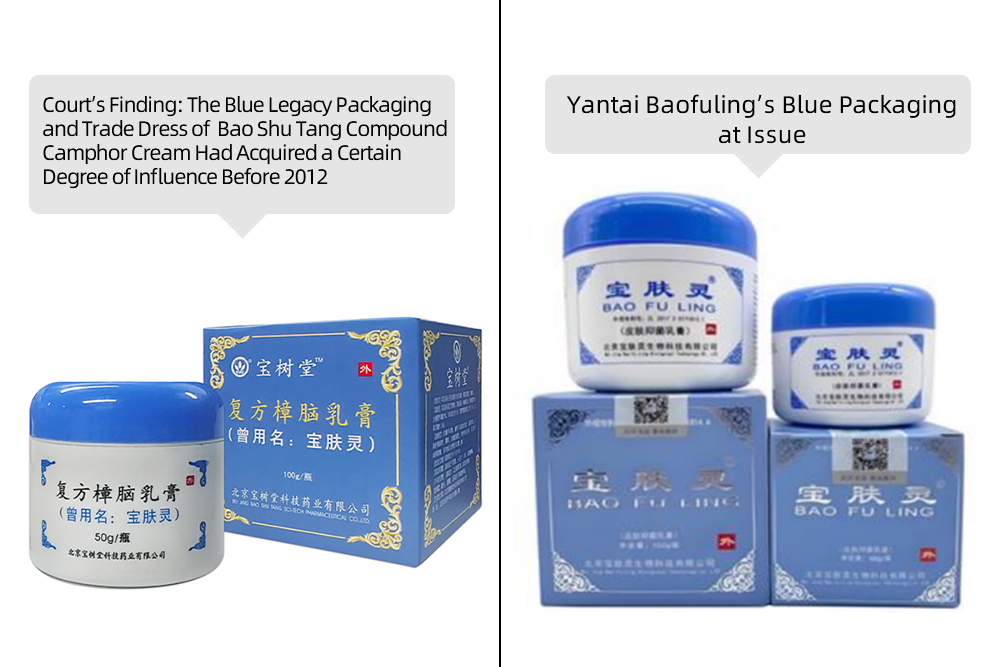
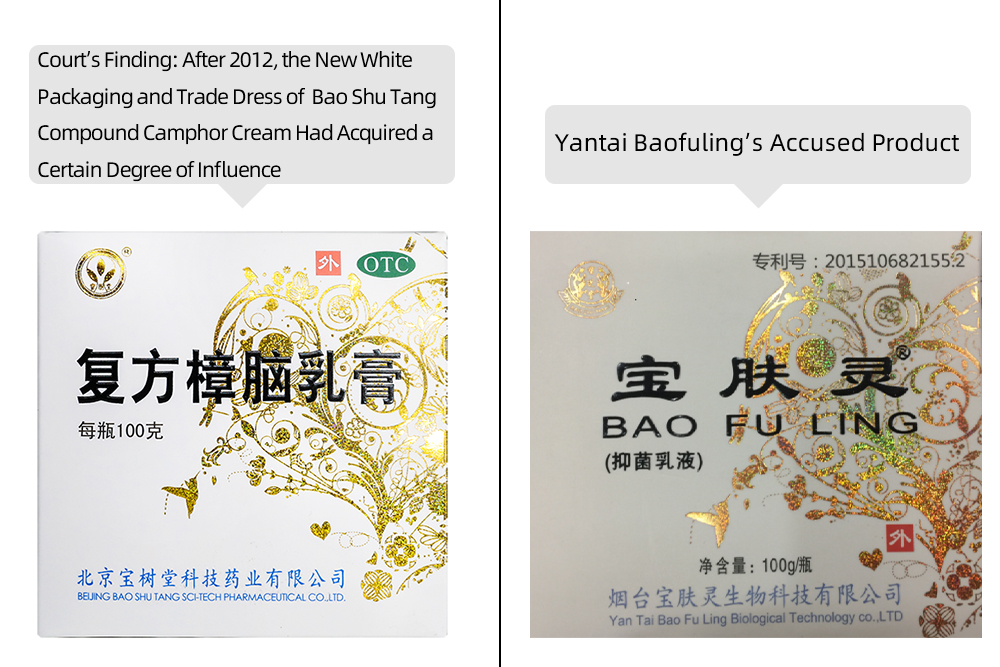
Yantai Baofuling, Gong Peizhou, Gong Jucong, and Sun Xin appealed the first-instance judgment to the Shandong High People’s Court. On March 27, 2026, the Shandong High People’s Court issued Final Judgment (2025) Lu Min Zhong No. 1451. The court held that Bao Shu Tang’s packaging and trade dress had acquired a certain degree of influence, that the accused packaging was similar in overall visual effect to the white packaging of Bao Shu Tang Compound Camphor Cream, and that Yantai Baofuling, Gong Peizhou, Gong Jucong, and Sun Xin shared a common intent to infringe. Finding that the first-instance judgment had correctly established the facts and applied the law, the court dismissed the appeal and affirmed the original judgment.
Notably, the final judgment gave a clear response on the unfair-competition issue: the white packaging of Bao Shu Tang Compound Camphor Cream possessed a degree of originality and distinctive features that identified the source of the goods, had become well known to the relevant public, and therefore constituted packaging and trade dress with a certain degree of influence. Yantai Baofuling’s accused product was similar in overall visual effect to the white packaging of Bao Shu Tang Compound Camphor Cream and was objectively likely to cause confusion among the relevant public. The court’s confirmation of the similarity in packaging and trade dress and the likelihood of confusion provided direct legal support for restoring clarity and order to the market.
This is a representative case involving the coordinated protection of drug safety, intellectual property, and fair competition. It effectively connected criminal accountability with civil compensation and has significant demonstrative value for regulating the pharmaceutical market and protecting the lawful rights and interests of brand owners.
From the criminal-law perspective, the court strictly applied pharmaceutical-administration laws and expressly classified “passing off a non-drug product as a drug” as a counterfeit drug. The judgment strongly addressed the cross-border manufacture and sale of counterfeit drugs, protected the baseline of medication safety, and demonstrated the judiciary’s priority protection of the public’s right to health.
From the civil-law perspective, the case fully demonstrates the value of punitive damages for intellectual-property infringement. The court directly relied on the infringement facts established in the criminal judgment and treated the counterfeit-drug finding as core evidence of intentional infringement under serious circumstances. By applying punitive damages, it substantially increased the cost of infringement and created a strong deterrent. At the same time, the court looked beyond the company’s separate legal personality and found that the de facto controllers and shareholders had jointly infringed together with the company and were jointly and severally liable. This prevented infringers from evading responsibility by characterizing the conduct merely as “corporate conduct” and strengthened the accountability framework for intellectual-property infringement.
More importantly, the case squarely addressed the unfair-competition problem of consumer confusion caused by imitative packaging. Purchases of pharmaceutical products involve a high degree of trust, and consumers often identify authentic products quickly through brand names, trademark signs, packaging colors, and the design of bottles and boxes. By copying the white packaging of Bao Shu Tang Compound Camphor Cream, the accused product was effectively leveraging the market reputation Bao Shu Tang had developed over many years. The court’s clear finding helps consumers understand that the authentic product is Bao Shu Tang Compound Camphor Cream, while the accused product is an imitation and is neither authorized by nor associated with Bao Shu Tang.
The case also provides a reference for corporate rights enforcement. When a brand owner encounters counterfeiting and infringement, it may first use criminal procedures to preserve infringement evidence and pursue criminal responsibility, and then rely on an effective criminal judgment to advance civil litigation. Such coordinated criminal and civil enforcement can efficiently achieve the goals of stopping infringement and obtaining full compensation. Enterprises should also attach great importance to protecting packaging and trade dress. By using comparison images of genuine packaging, photographs of enforcement seizures, sales evidence, and evidence of consumer confusion, a brand owner can clearly demonstrate the chain of harm—“imitative packaging, consumer confusion, and damage to brand reputation”—and more effectively protect brand value and market order.
When purchasing related products, consumers should look for the marks “宝树堂,” “BAOFULING,” and “宝树堂宝肤灵,” verify Bao Shu Tang’s official sales-channel information, and check whether the outer packaging carries a “drug traceability code.” The drug traceability code is the unique “identity code” for each box of medicine and is an important basis for identifying legitimately manufactured pharmaceutical products. Consumers should exercise particular caution with products that have similar names, similar packaging, unclear sources, or no drug traceability code, so as to avoid mistakenly purchasing imitations because of packaging confusion.